
Prospective homebuyers are drawing a clear line between when they’re comfortable using AI and when they want human expertise.
NEWS
Price Cuts on the Rise Across the Mid-Atlantic
Bright Research shares where and why price cuts are becoming more common, and what it means for sellers.
Despite home prices at record highs, there are definite signs that the market is shifting in the Mid-Atlantic. In June 2026, the median sold price in the Bright MLS footprint hit a new high of $460,000, and sellers are still sometimes getting multiple offers, even in a softening housing market. Higher-income buyers continue to drive sales and push up home prices, but affordability constraints are keeping moderate-income and first-time buyers out of the market.
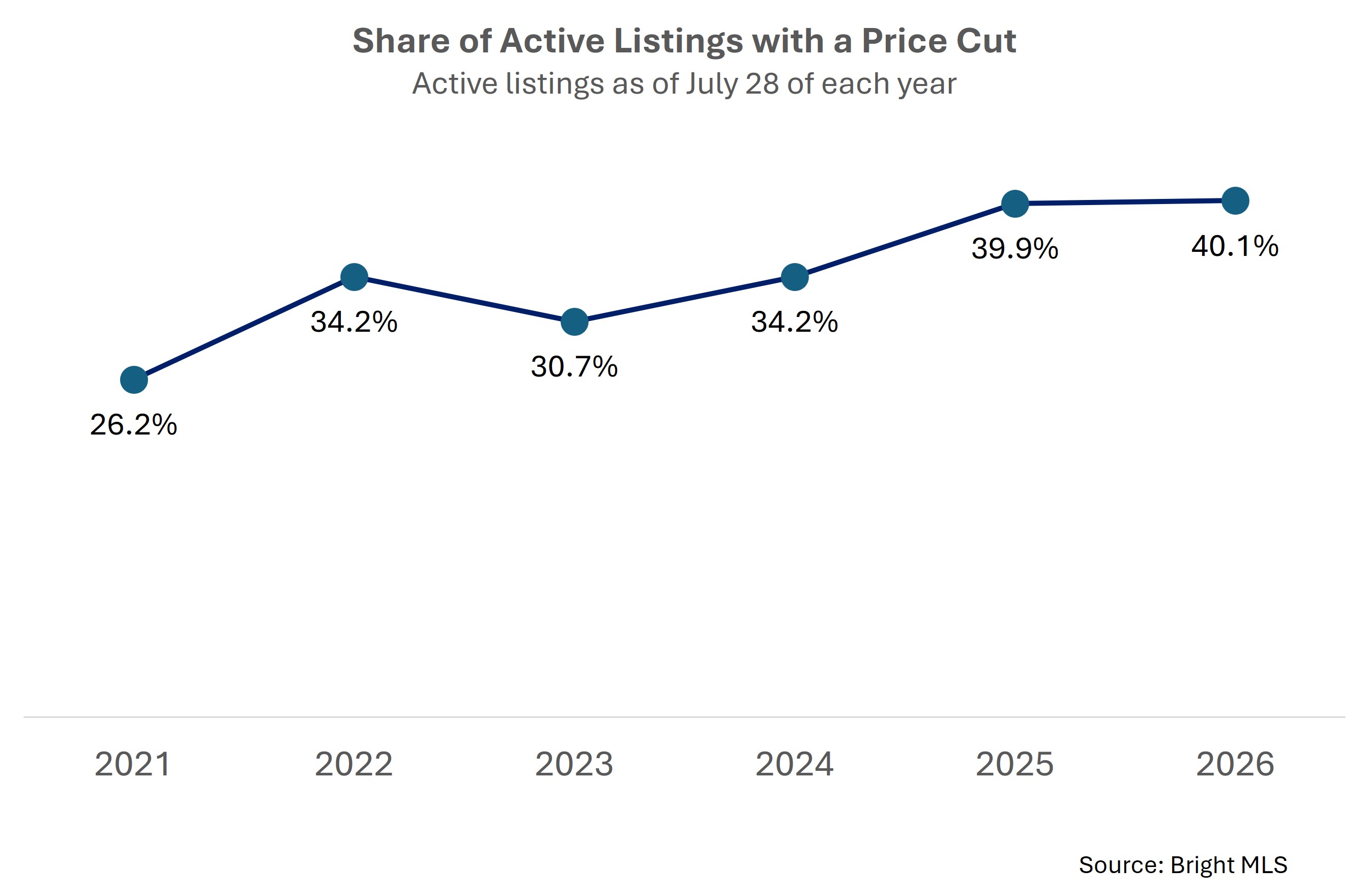
Because of this pushback on affordability and shifting buyer demand, sellers are having to adjust their expectations. Across the Bright MLS service area, 40.1% of listings currently on the market have undergone at least one price reduction. (Data are for listings active as of July 28, 2026.) But price cuts are not happening uniformly. The likelihood that sellers will need to drop their asking prices depends strongly on local market conditions as well as how long the home has been on the market.
Sellers have been reacting to changes in the market over the past two years. In 2024, only about a third (34.2%) of active listings had a price cut. The share rose to 39.9% in 2025 and to 40.1% in 2026.
Sellers in coastal markets are most likely to cut asking prices
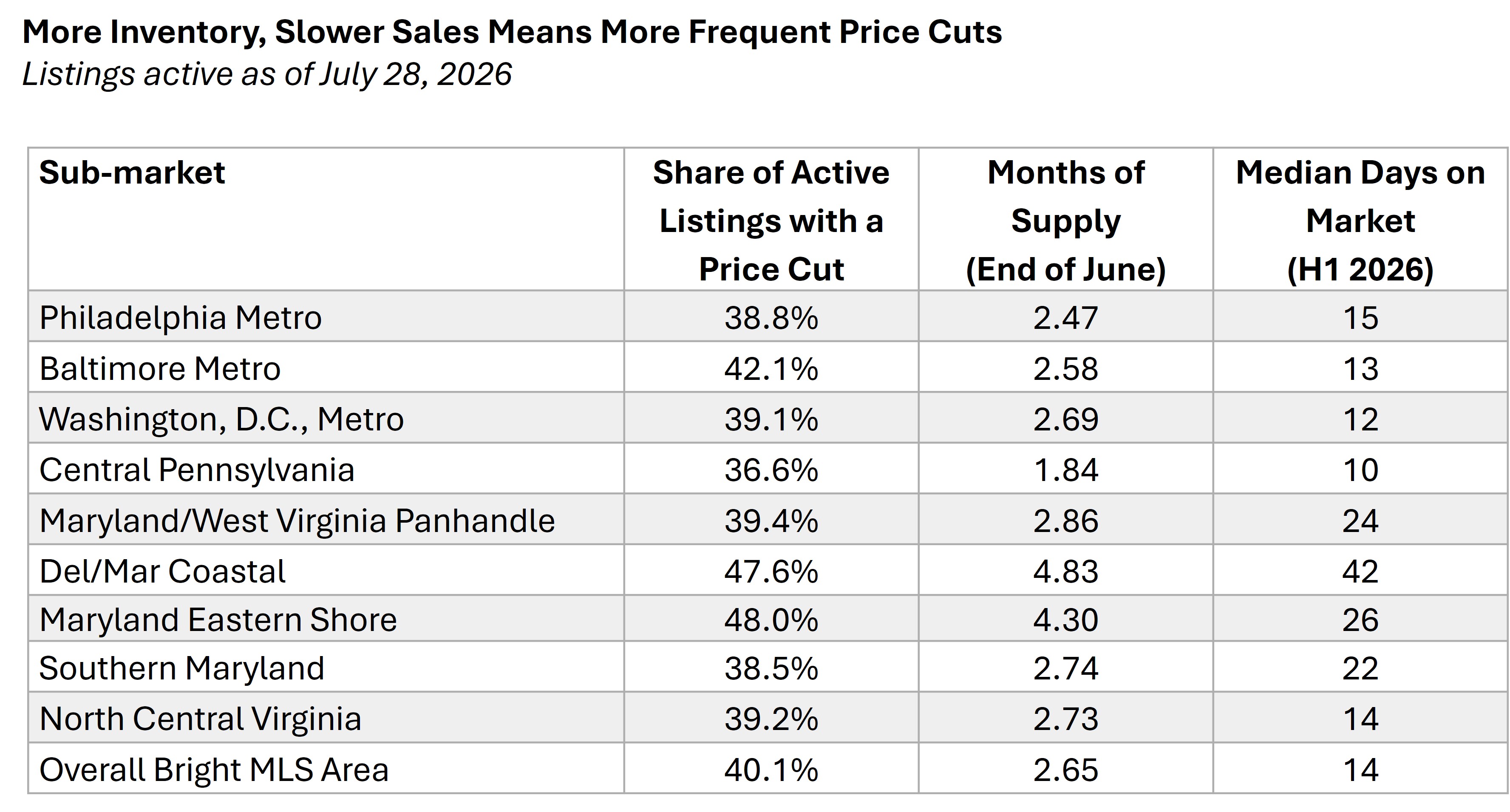
The Maryland Eastern Shore and Del/Mar Coastal regions lead the Mid-Atlantic in price cuts. Nearly half of the active listings in these markets have had their asking price discounted by the seller.
The high rates of discounting are directly tied to cooling local market conditions, with climbing inventory and slower sales. Across all subregions in the Bright MLS service area, the Del/Mar Coastal region has the highest inventory at 4.83 months of supply, and through the first half of the year, the median days on market in the region is 42. In the Maryland Eastern Shore market, there is 4.30 months of supply and a median of 26 days on the market. (Overall, in the Bright MLS service area, there is currently 2.65 months of supply and the year-to-date 2026 median days on market is 14.)
By comparison, markets that are still highly competitive are less likely to have sellers cutting asking prices. In the Central Pennsylvania market, for example, there is just 1.84 months of supply and homes sell in a median of just 10 days. Only 36.6% of current active listings in the Central Pennsylvania market have had a price cut.
After a month on the market, sellers get more serious about pricing
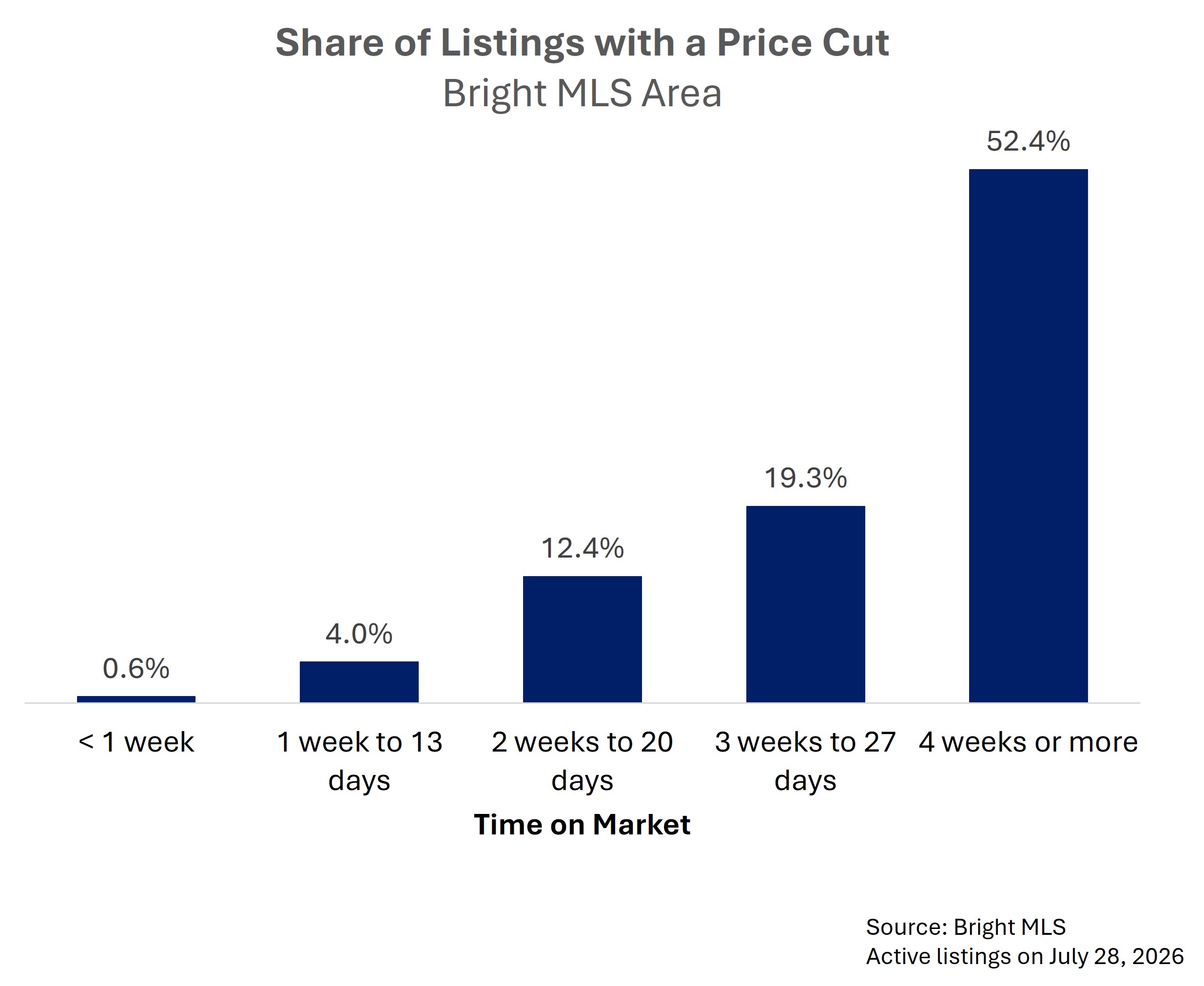
In all subregions in the Mid-Atlantic, time on market is the absolute strongest predictor of a price reduction. Sellers are very hesitant to drop prices immediately. Across the Bright MLS service area, only less than 1% of listings see a price cut in their first week. Even in the one-week to 13-day window, cuts are still relatively rare, with just 4.0% of active listings seeing a price cut.
However, once a property sits unsold for an extended period, the likelihood of a reduction increases significantly. More than half (52.4%) of listings that have been on the market for four weeks or more have had a price cut. In some areas, like the Baltimore metro and Del/Mar coastal regions, this figure is close to 60%.
Among active listings, sellers who have made a price adjustment are now listing their home at an average of 4 to 5% below their original price. Once a property is on the market a month or more, sellers get more aggressive. For properties listed for at least four weeks, the current list price averages 7% below the original list price.
What this means for sellers
In most markets in the Mid-Atlantic, it is still a good time to be a seller, particularly those selling at the higher end of the market. However, the days of testing an inflated price are over, and sellers need to be realistic about pricing. Overpricing a home increases the chance that it sits on the market and forces a more significant price reduction down the road. Sellers should work with a real estate professional with in-depth knowledge about local market conditions to set prices sensibly to attract active buyers quickly, avoiding the inevitable discounts that come with listings that linger on the market.
Exclusive Market Research & Analysis
Get the latest research and studies from Bright at BrightMLS.com/Research.
Recent articles
In this uncertain market, dropping the asking price does not guarantee more showings the following week.
Back to Top