
Some sellers have needed to adjust expectations, and their home’s price can influence how pressured they may feel to cut.
NEWS
Are America’s “Shadow Homebuyers” Really Ready to Buy?
Millions of young adults are stuck between what they earn and what it takes to buy a home.
Across the U.S., millions of employed adults between the ages of 25 and 39 are living with their parents. They have jobs and are earning money, raising the possibility that some are strategically using multigenerational living to save for a home. That has led to the idea of “shadow homebuyers,” young adults waiting on the sidelines who could enter the housing market as conditions improve.
But a closer look at the numbers suggests a more complicated story. This generation may be more stuck than strategic, with homeownership a distant prospect. In many of the markets where working young adults are most likely to live with their parents, there is an enormous gap between what they earn and the income needed to buy a typical home. Rather than representing a wave of buyers preparing to enter the first-time homebuyer market, many of these young adults may be living at home precisely because homeownership remains so far out of reach.
The “U-Turn” in Multigeneration Living
Multigenerational living among young adults has deep historical roots. According to historical U.S. Census Bureau data, nearly half of young adults in their 20s lived at home in 1940. That changed dramatically during the post-WWII economic boom. The rapid construction of affordable, suburban starter homes and the emergence of mortgage financing enabled young people to move out of their parents’ homes and purchase homes of their own. By 1960, less than 30% of 18- to 29-year-olds lived at home, and less than 8% of adults between 25 and 34 did.
The trend began reversing toward the end of the 1990s. Delayed marriage and childbearing, increased college attendance, and rising housing costs all contributed to more young adults living with their parents.
A recent Realtor.com analysis found that a record-high 25.2 million adults under 35, or 33.0% of all people ages 18 to 34, live with their parents. Similarly, recent Federal Reserve annual household survey data found that about half of adults under the age of 30 live with their parents, approaching levels last seen in 1940 but for very different reasons.
However, today’s young adult living at home isn’t the stereotype of a jobless college graduate playing video games and sleeping till noon. The Realtor.com analysis found that seven in 10 adults ages 25 to 34 who live at home are fully employed. But employment alone does not mean they are financially positioned to buy.
High Housing Costs Keeping Adult Children in Multigenerational Housing
To understand whether working young adults living at home represent a meaningful pool of future homebuyers, this analysis uses data from the 2024 American Community Survey 5-year file to examine the 50 largest metro areas. For purposes of the analysis, a potential “shadow buyer” is defined as an adult between the ages of 25 and 39 who lives in their parents’ home and is working.
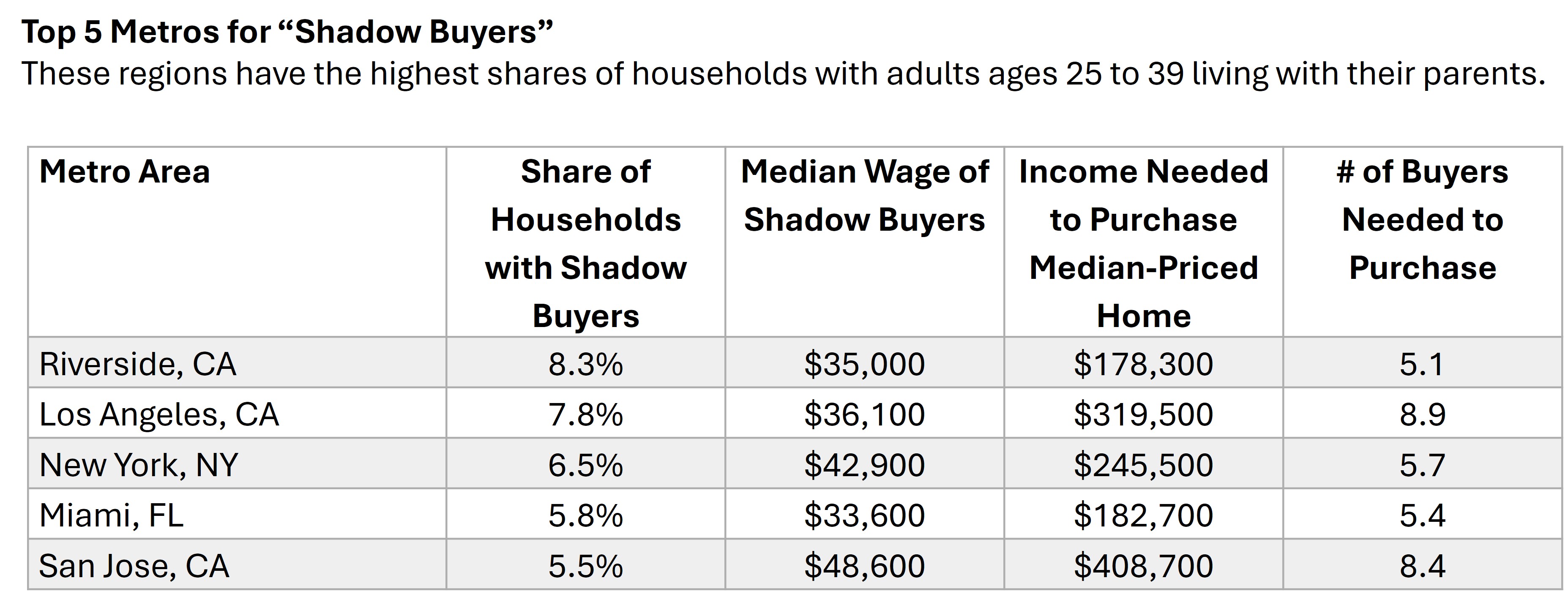
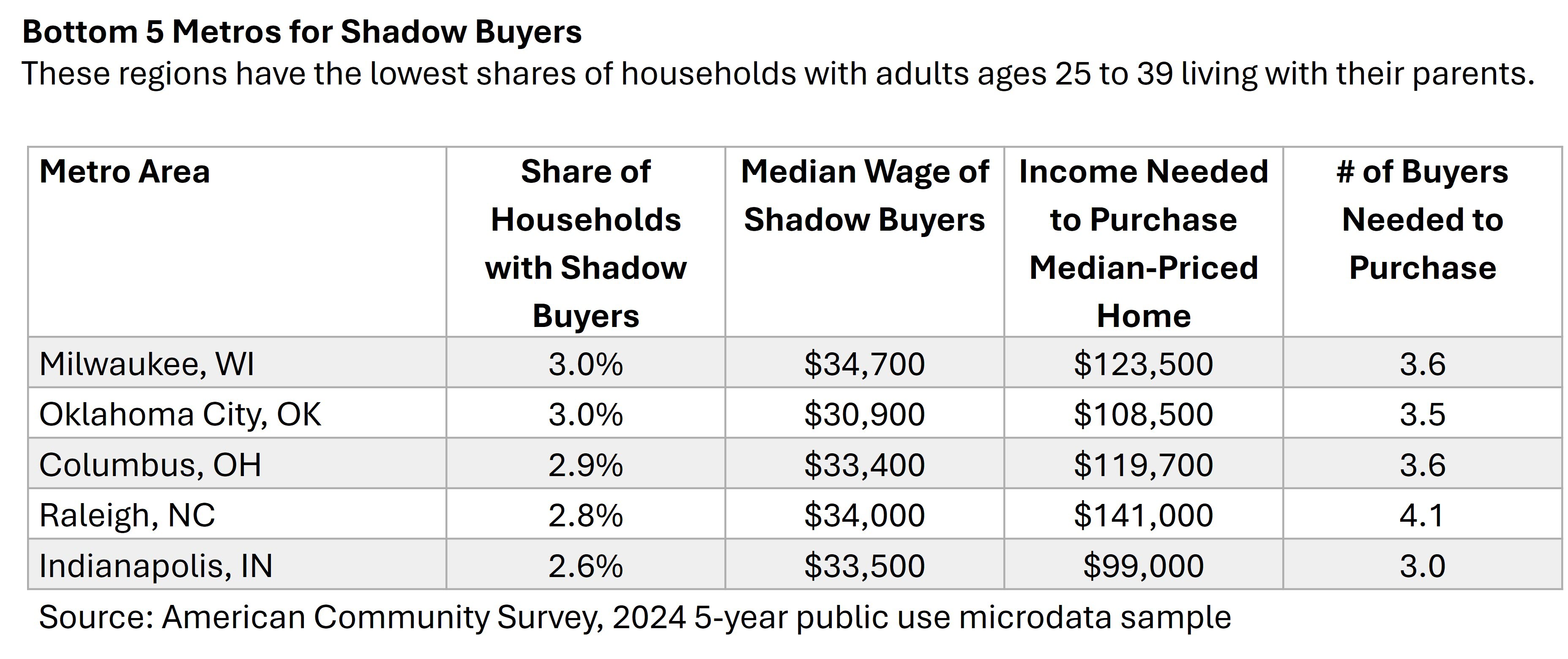
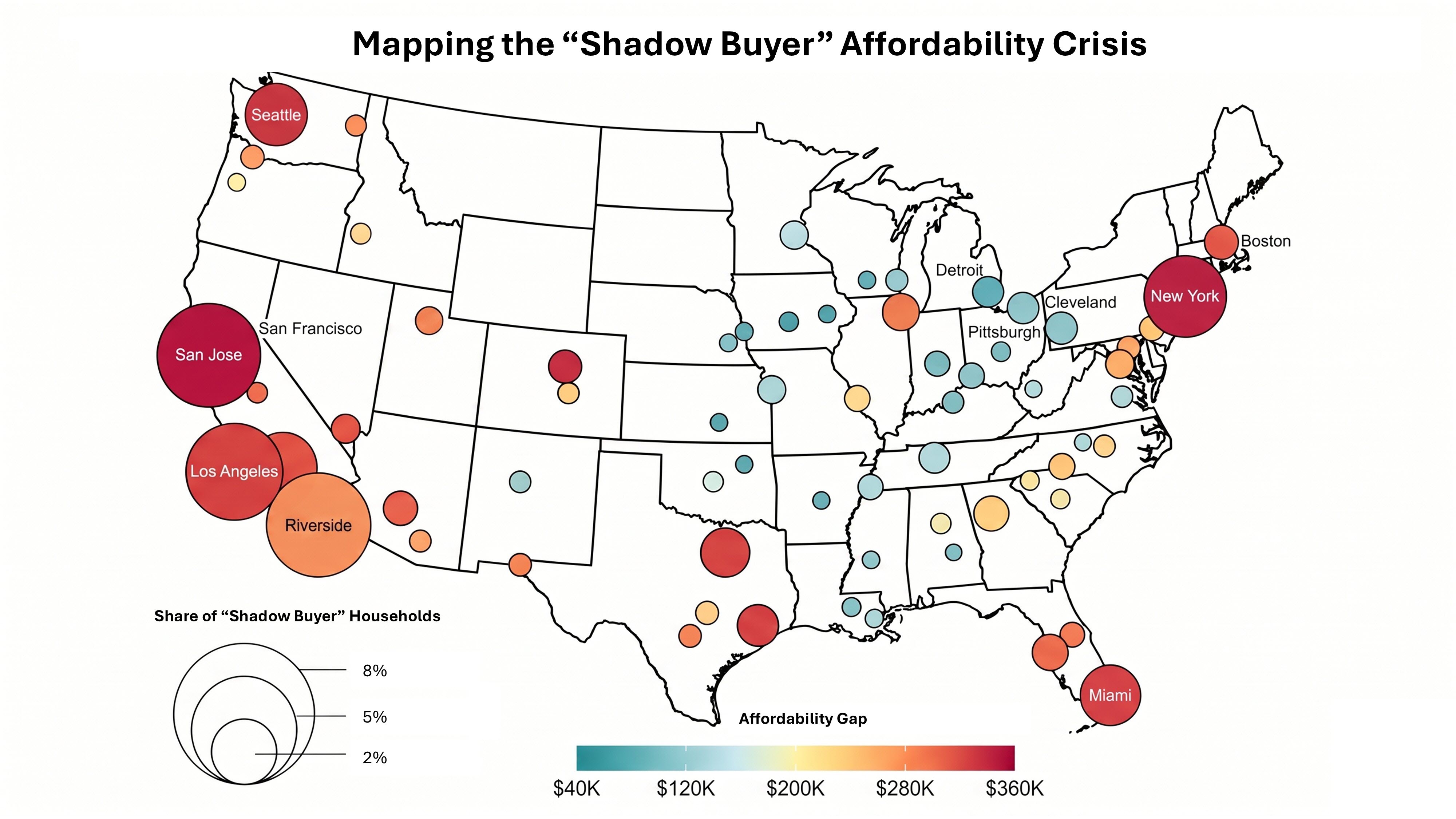
The results reveal a striking geographic pattern. The top 5 metros with the highest share of shadow buyers are all located in coastal states (California, New York, and Florida). The five metro areas with the lowest shares are all located in the Midwest or the interior South. The most important finding is what these young adults earn compared to what it takes to buy a home.
In the Los Angeles metro area, for example, nearly 8% of households include a shadow buyer. There is a massive affordability chasm in that market. The median wage of these shadow buyers is $36,100, yet a prospective homebuyer needs an income of over $300,000 to qualify to purchase the median-priced home in the metro area. It would take about nine of these shadow buyers to pool their incomes to be able to purchase the typical home in the Los Angeles area. That disparity is similarly stark in the San Jose, CA, metro area. The median wage of a shadow buyer is almost $50,000, but a buyer needs more than $400,000 to qualify to purchase the median-price home, more than eight times what the shadow buyer earns.
The affordability gap is not quite as large in other markets with relatively large shares of shadow buyers, but the underlying pattern remains: Housing costs are a major reason adults are living with their parents. As a result, it is a stretch to think that there is a significant pool of true shadow buyers that is getting set to be unleashed in these high-cost markets in the next year or two. Instead, these are the regions where young adults are getting further behind in terms of their ability to begin wealth creation through homeownership.
In the Mid-Atlantic, the Shadow Buyer Story Is Suburban
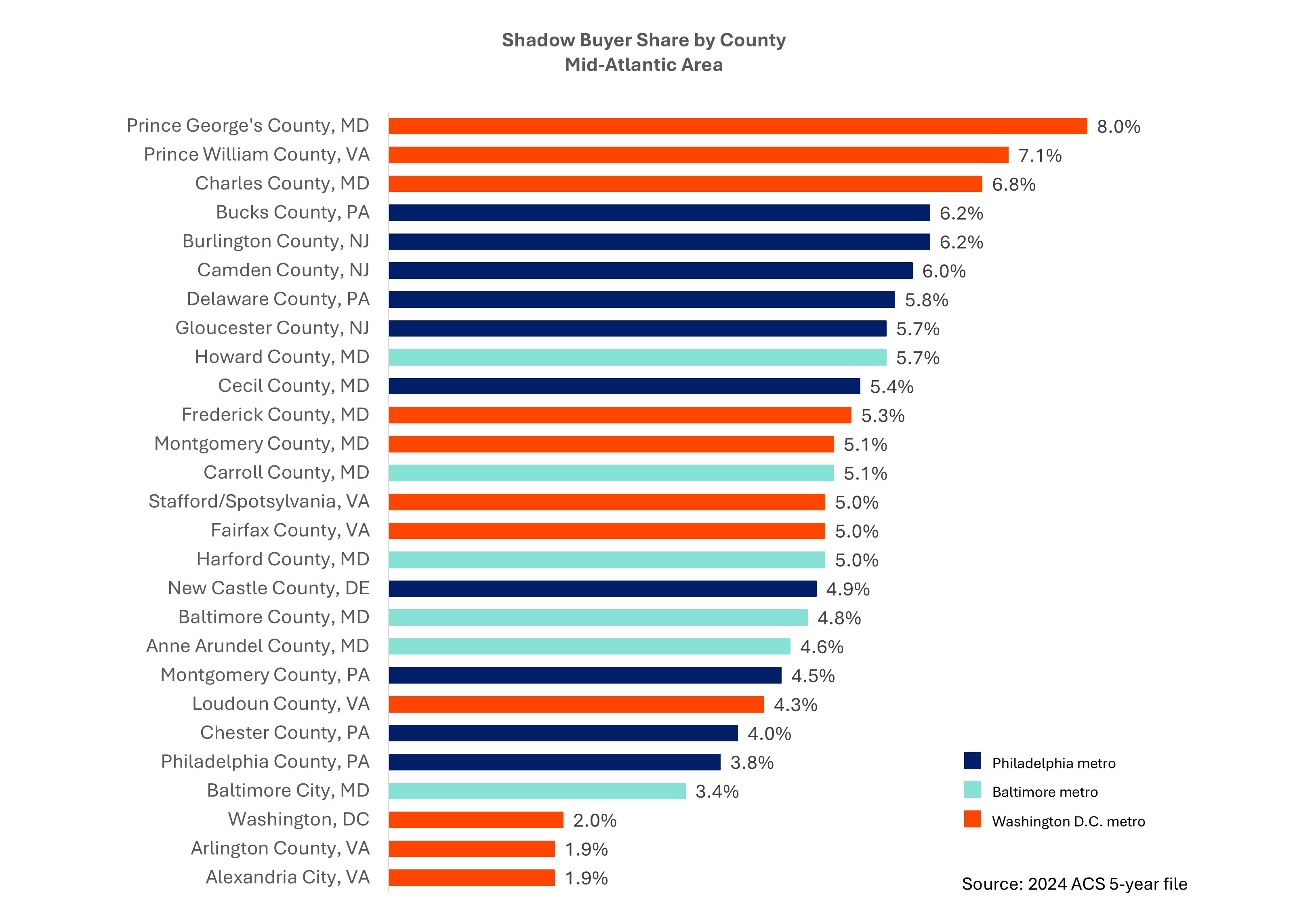
A closer look at the Bright MLS service area, which includes the Philadelphia, Baltimore, and Washington, D.C., metro areas, reveals another important pattern: Working adults living with their parents are disproportionately concentrated in the suburbs rather than the urban core. The District of Columbia has a shadow buyer household share of just 2.0%, while the densely populated inner suburbs of Arlington and Alexandria are even lower, at 1.9%. Just 3.4% of Baltimore City households include a shadow buyer, while the share is 3.8% for Philadelphia County.
Moving farther into the suburbs, however, the numbers rise substantially. The hotbeds of co-living pressure are the middle-ring and outer suburbs. Prince George’s County, MD, has the highest share of shadow buyer households in the Mid-Atlantic region at 8.0%. Prince William County, VA, follows at a 7.1% share, while Charles County, MD, has a 6.8% share.
These suburban markets represent two distinct economic realities.
1. Workforce Suburbs: In places such as Prince George’s and Prince William, larger single-family housing stocks make multigenerational co-living physically more feasible. At the same time, rising home prices encouraged more moderate-income families to pool household wages and make living together economically advantageous.
2. Affluent Suburbs: Places such as Howard County, MD, and Bucks County, PA, tell a somewhat different story. Young professionals may earn strong wages, but local entry-level home prices can still make purchasing independently difficult, keeping them in their parents’ homes longer.
Not Quite a Generation of Buyers Waiting in the Shadows
The term “shadow buyer” implies someone waiting just offstage, working, saving, and preparing to enter the housing market when the opportunity arises. The data suggests that description may fit some young adults living at home, but it does not fit all of them. In many markets, the income required to purchase a typical home dramatically exceeds what young adults earn. That means a small drop in mortgage rates or an improvement in inventory may not be enough to turn them into homeowners. The growth of multigenerational adults living under one roof is a sign of the widening divide between incomes and home prices.
This has implications on the time young adults are buying their first home, as the data shows them making their first-time purchase much later than earlier generations. The National Association of REALTORS reported that the median age of a first-time homebuyer hit a record high of 40 in 2026. This analysis shows that the problem is not a lack of employment, but rather a disconnect between incomes and housing costs that have led to this massive demographic backup in the homebuying population.
As a result, it is probably more appropriate to refer to these people as “sidelined buyers,” young adults who are financially prepped and eager to enter the market but who are riding the homebuying bench until affordability improves.
Rather than a generation of homebuyers waiting in the shadows, many young adults are showing us just how difficult it is to enter the housing market. There is a need for more affordable homeownership options. The solution is not necessarily to build more apartments in the cities, though there are some markets where there is a shortage of housing of all kinds. Instead, to unleash pent-up demand among first-time buyers, the focus needs to be on facilitating the construction of smaller homes, including townhomes, cottage courts, and starter-sized single-family homes, that can start to bring the cost of homeownership to a place that is more attainable to young adults.
Exclusive Market Research & Analysis
Get the latest research and studies from Bright at BrightMLS.com/Research.
Recent articles
Bright Research shares where and why price cuts are becoming more common, and what it means for sellers.
Back to Top